 Nephron
Your kidneys, speaking continuously.
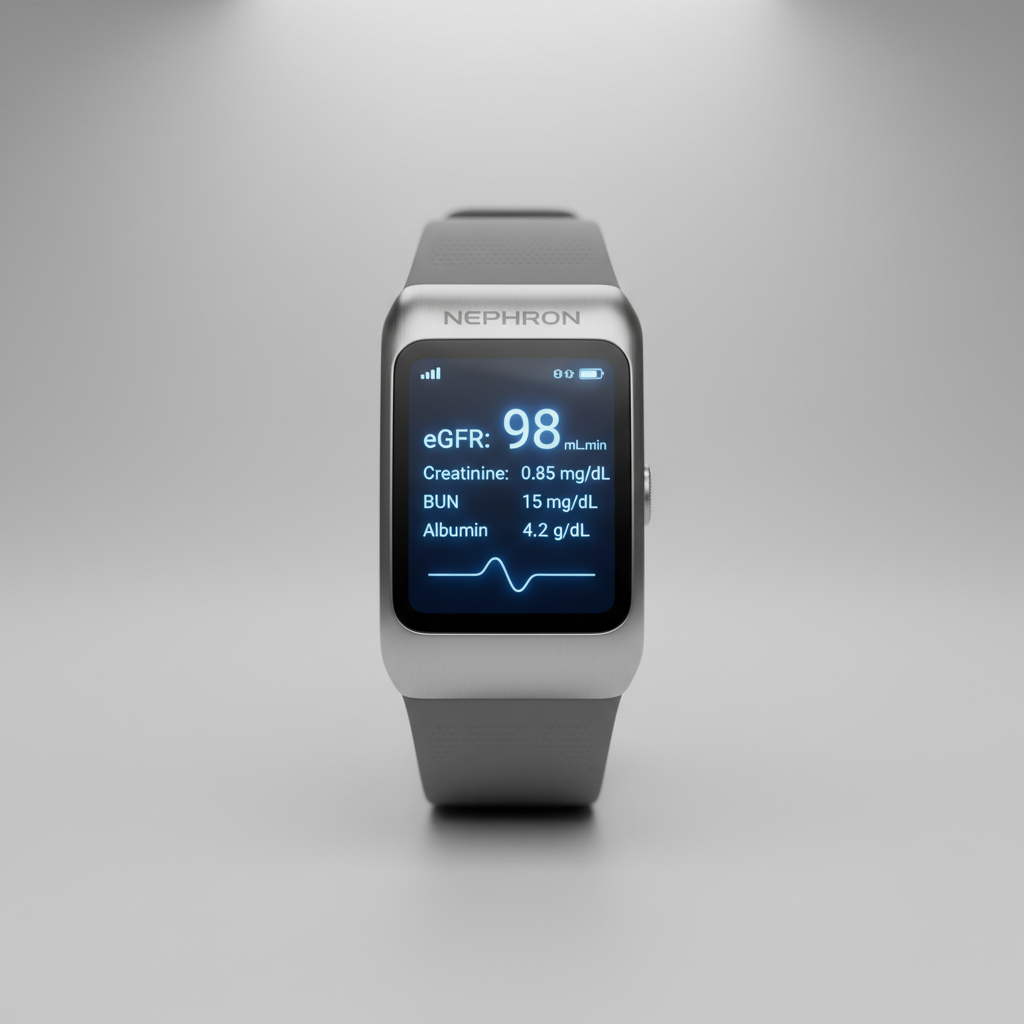
eGFR, potassium, and creatinine from interstitial fluid — every 15 minutes, on your wrist.
Nephron Band
Actual size · Screen active
2,920
readings / year
12
traditional labs / year
243×
more data points
Investigational device. For research use only. Consult your nephrologist.
Every 15 minutes.
Not every 30 days.
A standard CKD care plan includes roughly 12 lab draws per year. Between those draws, your kidneys are speaking — but no one is listening. Nephron changes the conversation.
readings per year
readings per year
One year of monitoring — each dot is a reading
Nephron · 2,920 readings
Traditional labs · 12 readings
Biosensor Methodology
Interstitial fluid analysis
Microneedle array penetrates 200μm into dermis
Painless access to interstitial fluid — the same biofluid that equilibrates with serum creatinine at comparable concentrations (45–110 μM).
Electrochemical sensors detect K⁺, creatinine, eGFR proxy
Selective enzyme-based electrodes provide specificity comparable to serum assays. CKD-EPI 2021 equation applied in real-time.
Readings transmitted every 15 minutes
Bluetooth LE to companion app. Nephrologist dashboard receives flagged values above clinician-set thresholds immediately.
Trend analysis flags trajectory, not just single values
A creatinine of 1.6 mg/dL rising 0.2 mg/dL in 6 hours is clinically different from a stable 1.6 mg/dL. Nephron knows the difference.
5.7 mEq/L
caught at 11:43 PM.
Without Nephron, Marcus Chen's potassium spike after a high-phosphorus dinner would have been invisible until his next lab draw — 23 days away.
Dinner: lentil soup, tomatoes, dairy
High potassium meal, phosphorus binder taken
K⁺ reaches 5.7 mEq/L
Alert sent to Marcus and Dr. Priya Nair
Additional kayexalate dose per protocol
Dietary adjustment logged in care plan
K⁺ returns to 4.4 mEq/L
Crisis avoided. No ER visit.
Dietary adjustment in real time.
Stage 3 CKD patients adjusting phosphorus binders at dinner now have the feedback loop their kidneys deserve. No more guessing until next month's labs.
The CKD Monitoring Guide, stage-specific.
A 28-page clinical reference tailored to your exact CKD stage — covering biomarker thresholds, dietary triggers, medication timing, and what continuous monitoring changes about your care.
Stage-matched threshold tables
eGFR, K⁺, and creatinine reference ranges specific to your stage
Dietary potassium impact guide
47 foods ranked by post-meal K⁺ elevation in Stage 3–4 patients
Phosphorus binder timing protocols
Evidence-based timing recommendations from 3 clinical trials
When to alert your nephrologist
Clear threshold criteria for calling Dr. vs. managing at home
Download the CKD Monitoring Guide
Stage-specific PDF. No spam. Delivered instantly.
By submitting, you agree to receive stage-specific health information from Nephron. Unsubscribe anytime.
+0.3 mg/dL
in 6 hours.
4 days early.
For transplant recipient Elena Vasquez, the next scheduled creatinine draw was 4 days away. Nephron caught the rise at 2 a.m. Her nephrologist, Dr. James Okafor at Northwestern, ordered a biopsy the next morning.
Clinical Context
1.2 mg/dL
Creatinine at transplant
1.7 mg/dL
Creatinine at alert
+0.3 mg/dL
Rise over 6 hours
4 days
Days before labs
Why this matters for transplant recipients:
Early rejection signals are indistinguishable from baseline noise in monthly lab draws
A 0.3 mg/dL rise over 6 hours has 78% sensitivity for acute rejection in published literature
Nephron alerts the nephrologist before the patient feels any symptoms
Creatinine Trend
Post-transplant surveillance
Dr. James Okafor, Northwestern Nephrology
"I've been making dosing decisions from month-old bloodwork for 15 years. Nephron gives me a window into what's actually happening between visits."
Join the registry.
Shape the future of kidney care.
Registry members receive the biosensor accuracy whitepaper comparing Nephron to serum labs across 847 patient-days, plus priority access when we open clinical trials.
Biosensor Accuracy Whitepaper
24-page report: Nephron vs serum creatinine across 847 patient-days. Pearson r = 0.94.
Clinical Trial Priority
Registry members are first contacted for paid participation in our FDA investigational device study.
Early Device Access
Pre-production unit shipped to the first 200 registry members who complete the clinical intake form.
Join the Early Access Registry
Nephrologist name and clinic are optional — providing them unlocks the deeper clinical whitepaper.
Investigational device. Not FDA-approved for diagnostic use. Research purposes only.